Vietnam agricultural products sourcing for EU buyers requires more than finding a supplier with a low quotation. EU buyers increasingly need traceability, document discipline, food safety awareness, supplier screening and a practical understanding of border control risks before placing commercial orders.
Green Tech Agri Export helps international buyers act with better local visibility in Vietnam. We help clarify product specifications, shortlist suitable suppliers, compare quotations, coordinate samples and prepare document questions before the buyer moves toward contract discussion.
Why EU sourcing from Vietnam needs stronger preparation in 2026
Vietnamese agricultural, forestry and fishery products continue to expand globally. Vietnam’s Ministry of Agriculture and Environment reported nearly US.8 billion in exports in the first seven months of 2026, up 7.5 percent year on year. The same ministry noted that Europe accounted for 13.8 percent of export market share for these products.
At the same time, the EU continues to enforce risk-based import controls. For EU buyers, the practical question is not only whether a Vietnam supplier can produce the product, but whether the product, documents, traceability system and certificate pathway are suitable for the target EU market.
Vietnam product categories EU buyers often compare
| Category | EU buyer opportunity | Pre-screening focus |
|---|---|---|
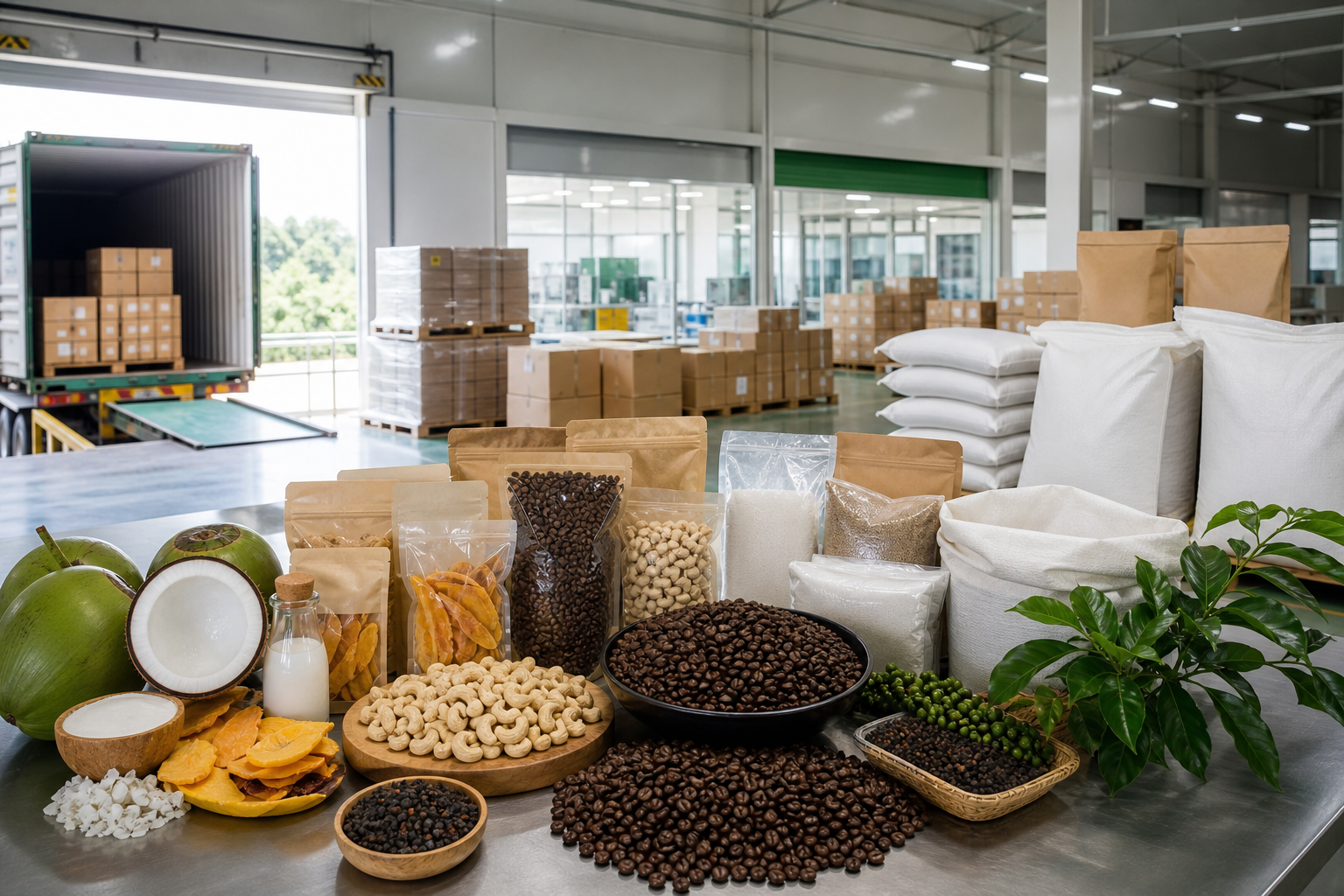
| Coffee beans | Roasters, traders, private-label coffee brands | Origin, crop year, defect count, moisture, processing method, sustainability documents where required |
| Cashew nuts | Ingredient buyers, snack importers, retail packs | Grade, broken rate, aflatoxin control awareness, allergen handling, packaging |
| Pepper and spices | Seasoning, ingredient and food manufacturing | Pesticide residue expectation, microbiology, steam treatment, density and lot traceability |
| Soft dried fruits | Snack brands, ethnic retail, gifting and private label | Sulphite declaration, sugar level, water activity, shelf life, retail label readiness |
| Coconut and aloe vera | Beverage, dessert, bakery and food ingredient | Format, ingredient declaration, shelf life, certificate scope, batch consistency |
| Seafood and selected fruits | Food service, frozen seafood, specialty retail | Establishment eligibility, cold chain, residue controls, phytosanitary or animal-origin documents |
EU import control points buyers should understand
The European Commission explains that EU border authorities perform documentary checks, identity checks and physical checks at designated Border Control Posts for food and feed products that fall within the relevant control scope. High-risk goods may face systematic controls depending on product, origin and risk profile.
For certain food and feed of non-animal origin under increased controls, EU authorities may require systematic document checks, physical checks at defined frequencies, and in some cases sampling analysis results and official certificates from the relevant third country.
A practical EU buyer checklist before requesting samples
| Checkpoint | What to ask Vietnam suppliers | Why it matters for EU buyers |
|---|---|---|
| Product identity | Scientific/common name where relevant, HS direction, processing format, grade | Helps align import controls and documentation route |
| Traceability | Lot system, packing date, origin area, processor/packer information | Supports recall readiness and buyer QA review |
| Food safety records | COA, microbiology, pesticide residue or mycotoxin testing where relevant | Reduces risk of mismatch with buyer and EU expectations |
| Certificates | Phytosanitary, health certificate, origin, Halal, Organic or other scope if required | Confirms whether the supplier can support the target order |
| Packaging and labeling | Bulk carton, retail pack, language, allergen, nutrition and private-label direction | Affects compliance, shelf readiness and logistics cost |
How a Vietnam-side sourcing representative helps EU buyers
For EU buyers, sourcing support should not stop at forwarding supplier catalogs. The useful work is in clarifying the requirement, asking suppliers the same questions, comparing answers in a structured way and identifying gaps before samples and commercial negotiations.
Green Tech Agri Export supports this process by preparing supplier-ready RFQs, screening product-category fit, coordinating sample conversations and helping buyers understand what documents may need to be confirmed with the supplier, importer, customs broker or competent authority.
Recommended sourcing workflow for EU importers
- Define product specification, grade, volume and use case.
- Confirm destination country and buyer compliance expectations.
- Shortlist Vietnam suppliers by product fit and document readiness.
- Compare quotations on the same specification, not on loose product names.
- Request samples only after packaging, certificates and testing direction are understood.
- Use pre-order checks to reduce document, traceability and logistics surprises.
FAQ
Can Green Tech Agri Export act as the EU importer?
No. We act as a Vietnam-side sourcing representative. EU importers should work with their own customs broker, importer of record and compliance advisors for final regulatory decisions.
Which Vietnam products are practical for EU sourcing?
Coffee, cashew nuts, pepper, spices, soft dried fruits, coconut products, aloe vera ingredients, rice and selected seafood categories are practical starting points, depending on buyer specification and compliance requirements.
What should EU buyers send in the first RFQ?
Send product name, target grade/specification, destination country, expected volume, packaging format, certificate needs and whether the order is for bulk, retail or private-label supply.
Need help shortlisting Vietnam suppliers for the EU market?
Send your product requirement and we will help prepare a supplier-ready RFQ and sample discussion plan.
Sources used: